
Customers engage with businesses online and offline to fulfill their needs and wants. As they do so, they leave clues about these demands in terms of items searched, reviews read, ads clicked, pages viewed or goods purchased. In turn, the marketers leverage this information to retarget these customers. Although this is a fine method of targeting – aka behavioral targeting or BT, there are several issues with this approach.
First, these are actual behaviors; as such they are limited in volume to scale to today’s marketing campaign needs. Second, by the time the marketers reach these users or customers, it is highly probable that the need/want behind these customer actions online and offline has already been fulfilled. This reach gap makes the message/offer untimely and irrelevant to the customer/user. Finally, even when all appears under control, the offer may still be the wrong one for the customer.
Most marketers today pick out customers for their campaigns as they are organized by product lines or categories (product-centric approach) rather than picking the most relevant campaign/ offer to the customer (the customer-first approach). The revenue pressures from the product categories also contributes to this issue. It is not uncommon for the category that makes the lion’s share of the revenue to bully their way onto the largest campaign audience available for targeting.
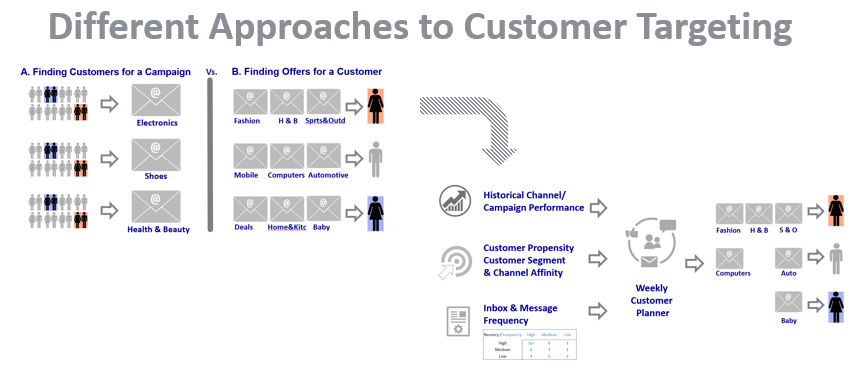
When marketing/ sales campaigns are set to maximize revenue or profitability – rather than the relevance of the offer/ message to the customer, the customer needs are not served. If your business goal this period dictates promoting more electronics to boost the revenues, this is irrelevant to most customers, e.g., Jenny and John might be up for shoes and gardening supplies, instead.
In a Customer-first undertaking, relevance replaces revenue and all functional areas of the business (management, finance, production/ product, procurement, supply-chain, logistics, finance, sales/ marketing, customer service…) are aligned with and work backwards from the customer. The enabler here is the business analytics/ machine learning optimized to the customer need/ want as opposed to the business goals of maximizing revenue or profitability.
When a business relentlessly pursues the Working-backwards strategies – proactively assessing its customers’ needs/ wants, consistently and continually adapting its business operations, communications, and connecting with the customers accordingly then it is eventually perceived as Customer-driven – or so goes the Amazon story. A possible list of Working-backwards strategies include:
- Customer communications, messaging, cross-sell/ up-sell recommendations, digital marketing (SEO/ SEM), social targeting driven by customer relevance (consideration, preference, conversion)
- Promotion planning based on customer response and channel affinity
- Online and offline advertising based on customer clickthrough and conversion propensities
- Inactivity and churn managed, and loyalty rewarded, based on customer lifecycle segmentation and predictive targeting
- Life-stage events (birthday, student, newly wedded, new parent, retirement) and lifestyles (diets, on-the-go professional, deal-seeker, brand-loyal, luxury-buyer) anticipated for and proactively communicated
- Pricing decisions based on customer sensitivity to changes in price (pricing elasticity of demand)
- Shipping and handling rates optimized according to customer sensitivity (cart abandonment rate)
- Inventory and assortment planning decisions based on customer demand
- Contact center, customer service and delivery operations prioritized according to customer segment and lifetime value
- Store layout and space allocation driven of customer behavior, survey and planograms
- The ranking of sellers (in a marketplace setting) modeled after consumer choice and seller performance – not just the price
- The back-office operations and planning (financial planning, fraud detection, warehouse optimization/ layout planning and logistics) based on customer demand, share of wallet and lifetime value
All these and more lie in the data, awaiting to be discovered. When a business makes data-driven magic for its customers, when the customers feel they are treated individually – not as a segment, when their needs/ wants are anticipated for and communicated, then an enduring, rewarding relationship, a silent dialogue with the customer is activated.
With its data science, engineering, real-time platforming and experimentation capabilities DatAcxion can help your business make data-driven decisions in this Customer-first economy for double-digit growth in customer engagement, loyalty and lifetime value.
Leave a Reply